Published June 25, 2026
World Cup Fever, Adlands Fleeting Escape from AI
For one glorious week on the French Riviera, something pleasantly unexpected happened.
Artificial intelligence stopped being the only thing anyone in advertising wanted to talk about.
Not completely, of course. Let’s not get carried away.
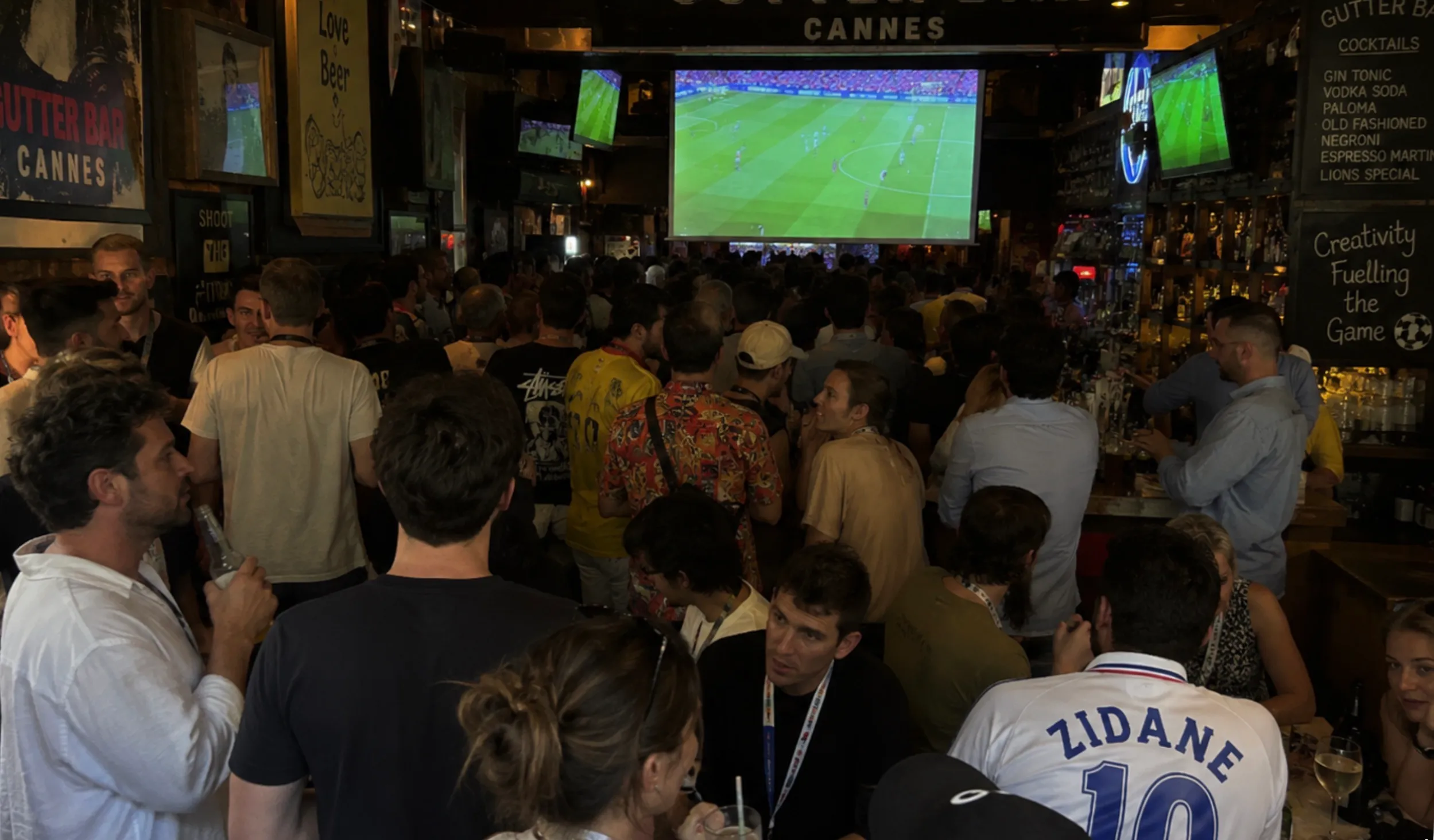
But as the FIFA World Cup played out alongside Cannes Lions, there were moments. Good moments. Loud moments. Slightly chaotic moments. Moments when agency leaders, marketers, consultants, tech execs, VCs, founders and the occasional self-declared futurist put their AI opinions on pause and talked about something else.
Football.
All along the Croisette, from beachfront cafés and crowded bars to hotel terraces, beach clubs and conference panels, the World Cup became a very welcome break from the endless stream of AI conversation starters.
“How is AI changing your agency?”
“What are you doing with AI workflows?”
“Will AI replace creatives?”
“Have you seen the latest model?”
By day three, plenty of the Cannes faithful could have answered those questions before the coffee and croissants arrived.
Then someone would look up at a screen.
A goal. A penalty. A group-stage scenario that needed an Etch A Sketch, a calculator and maybe divine intervention.
A debate about who was through, who was not, and who had somehow made the whole thing far more complicated than it needed to be, referees included. And just like that, the conversation changed.
For a few precious minutes, people became a different kind of futurist: football futurists, confidently predicting outcomes that were somehow even less predictable than any hallucination-plagued AI forecast.
The timing could not have been better.
While AI dominated, or at least permeated, every stage, seminar, activation and thought leadership session at Cannes, the World Cup reminded everyone that humans still love gathering around something gloriously unpredictable.
No prompt engineering.
No workflow automation.
No synthetic content.
Just twenty-two people chasing a ball and billions of people caring far more than logic would ever suggest.
As New Zealanders, we came into the tournament with our usual mix of optimism, realism and emotional self-preservation.
Let’s be honest. The All Whites were never favourites to top the table.
In fact, most of us would have been perfectly happy with “competitive underdogs” as a very respectable goal.
But that almost made it more fun.
There’s a special kind of joy in backing an underdog team. Every point feels earned when it finally comes. Every result matters. Every upset becomes a story worth telling again and again.
Much like so many indie agencies, come to think of it.
The World Cup also gave Cannes something it doesn’t always manage to deliver.
A genuinely shared experience.
Not a sponsored experience, not a curated experience, not a branded thought leadership experience with a velvet rope and a QR code. A global event that everyone could take part in, no matter their job title, company size, yacht allocation or beach club access.
The biggest irony of all may be that while AI was being talked about as the future of human connection, football was actually creating it in real time.
Strangers became temporary teammates.
Competitors became drinking buddies.
Agency leaders who had spent the morning debating machine learning suddenly found themselves arguing about offside rulings with the confidence of a Supreme Court judge.
And honestly, it was brilliant.
None of this takes away from the importance of AI.
The technology will keep reshaping agencies, workflows, production models and business operations in ways we’re only just beginning to understand.
But Cannes Lions 2026 offered a useful reminder.
The future may be powered by AI.
The present is still powered by good people, good instincts and the occasional collective yell at a screen.
And sometimes all it takes is a World Cup match on a jumbo screen mounted on the back of a B-train truck overlooking the Mediterranean to remind us of that.
For one brief week, football gave Adland a much-needed break from talking about artificial intelligence. Not a permanent escape, but enough of a pause to remember why the randomness of humans is still far more interesting. The serendipitous meetings, the chance encounters, the laughs and the jibes.
So even if the All Whites finish more towards the bottom of the table than the top, we’ll take those cherished memories away from the Croisette and look forward to whatever comes next.
More from Articles














![400% [Put in context for agency founders]](https://cdn.blutui.com/uploads/curation/img-8327.jpeg)


Sign up for our newsletter.
We partner with some extraordinary organisations