Published April 30, 2026
Who Does Blutui Compete With for Your Agency?
How a Kiwi Creative Ops Team Reframed an Entire AgencyTech Category
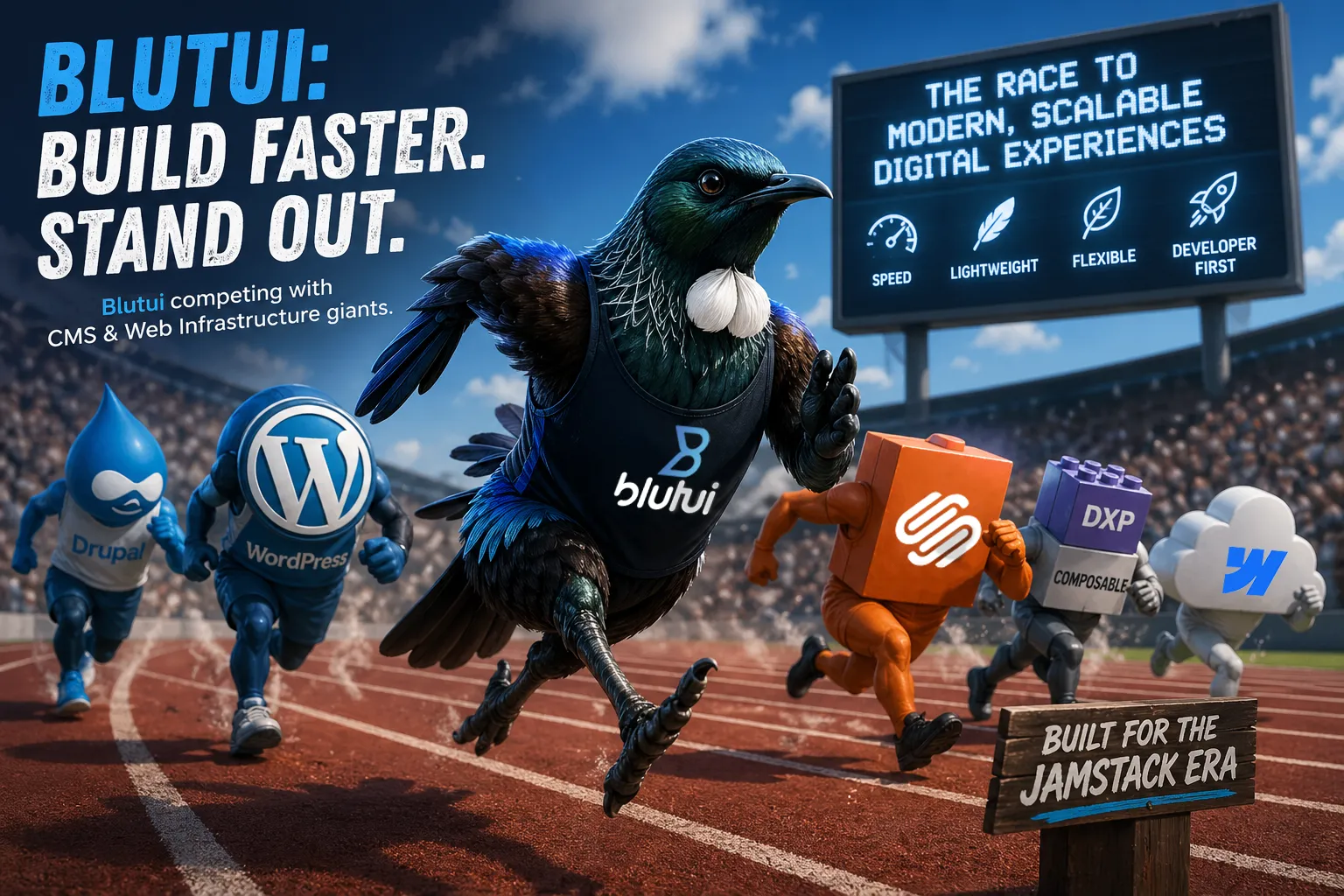
Blutui doesn’t compete in a neat, well-defined category.
That’s the first thing to get straight. It sits across several layers of the modern web stack and agency workflow, which means its “competition” is actually a fragmented mix of tools, platforms, and ways of working.
That fragmentation is precisely where Blutui provides the advantage.
The Competitive Landscape: Who Blutui Actually Competes With
1. Visual Website Builders
Platforms like Webflow and Framer sit closest on the surface.
They promise speed, visual control, and reduced reliance on developers. Webflow, for example, combines design and CMS in one interface, allowing teams to build and publish without switching tools. (Webflow)
Where they fall short:
Limited scalability for more complex builds
Constrained by platform rules and abstractions
Still require workarounds when projects move beyond “marketing site” territory
What they really are:
Design-led publishing tools, not true development ecosystems.
2. Headless CMS & Composable Stacks
This is where things get more technical:
Contentful
Sanity
Strapi
Storyblok
These platforms dominate modern “composable” architecture. They separate content from presentation and rely heavily on APIs and developer workflows.
They’re powerful, flexible, and widely adopted.
But there’s a catch:
Heavy developer dependency
Fragmented tooling (CMS + frontend + hosting + integrations)
Increasing cost and complexity as projects scale (Webflow)
Even small changes can require engineering input. That’s not a bug. It’s the model.
3. Enterprise DXPs (Digital Experience Platforms)
At the top end, you’ve got systems like Adobe Experience Manager.
These offer:
Personalisation
Asset management
Omnichannel delivery
But:
Expensive
Slow to implement
Overbuilt for most agencies
They solve complexity by adding more complexity.
4. No-Code / Low-Code Platforms
Tools like Bubble and similar entrants aim to remove the need for coding altogether.
Reality:
Great for prototypes
Weak for production-grade, scalable agency work
They trade capability for accessibility.
The Real Problem Across All Competitors
Across all these categories, the same structural issues show up for agency users:
1. Fragmentation
Teams are forced to stitch together multiple tools just to deliver a single project.
2. Developer Bottlenecks
Even “no-code” or “visual” tools quickly hit a wall where developers are required.
3. Workflow Inefficiency
Design, development, and content operate in separate systems, creating friction.
4. Scaling Pain
What works for one site breaks when applied across multiple clients, regions, or campaigns.
Where Blutui Is Fundamentally Different
Blutui isn’t trying to be a better CMS or a nicer builder.
It collapses the entire workflow.
1. From Tools → To System
Where competitors provide tools, Blutui provides a production system.
Instead of:
CMS + frontend + hosting + integrations
Blutui delivers:
A unified build environment
Component-driven architecture
Integrated deployment and scaling
2. Developer Empowerment, Not Replacement
Most platforms try to reduce the need for developers.
Blutui does the opposite. It amplifies developer talent.
Developers build reusable systems, not one-off pages
UX/UI is crafted properly, not approximated through visual editors
There’s no ceiling where you “outgrow” the platform
This is critical. Many tools feel fast until they don’t.
3. True Agency-Grade Scalability
Blutui is designed for agencies, not just websites.
That means:
Multi-project management
Versioning (Cassettes)
Parallel development workflows
Rapid iteration across clients
Most competitors are optimised for a site.
Blutui is optimised for a business delivering hundreds of sites.
4. Speed Without Compromise
Visual builders trade flexibility for speed.
Headless stacks trade speed for flexibility.
Blutui removes that trade-off.
Speed comes from reusable architecture and automation
Flexibility comes from real development capability
5. Commercial Impact (The Bit Competitors Avoid)
Most platforms optimise for:
Features
Usability
Adoption
Blutui optimises for:
Margin
Throughput
Capacity
That’s a different game.
It’s not about “can you build it?”
It’s about “how many can you build, how fast, and how profitably?”
Blutui . . . Priceless (to borrow a line from Mastercard 9n the ‘90’s)
New web-app project won: $250,000
3 months dev team salaries to deliver: $180,000
Scope creep, rework, missed deadlines, enterprise licenses: $120,000
Watching your margin, deadline and reputation disappear: painful
Building and delivering the same entire project in a fraction of the time, with a fraction of the resource, and none of the chaos?
Priceless
There are plenty generalist tools that will leave your agency underwater.
For all the smart agencies, there’s Blutui.
The Bottom Line
Blutui’s competition isn’t a single platform. It’s an entire way of working that the industry has accepted as normal:
Fragmented stacks
Developer bottlenecks
Inefficient workflows
Platforms like Webflow simplify.
Headless CMS platforms add flexibility.
Enterprise tools add control.
Blutui removes the need to choose between them.
That’s why it feels different. And why it doesn’t just compete. It reframes the category.
More from Articles





















![400% [Put in context for agency founders]](https://cdn.blutui.com/uploads/curation/img-8327.jpeg)



Sign up for our newsletter.
We partner with some extraordinary organisations