Published July 15, 2026
The End of the Complexity Economy
The digital economy rewarded organisations for adding complexity. The AI economy rewards those that remove it.
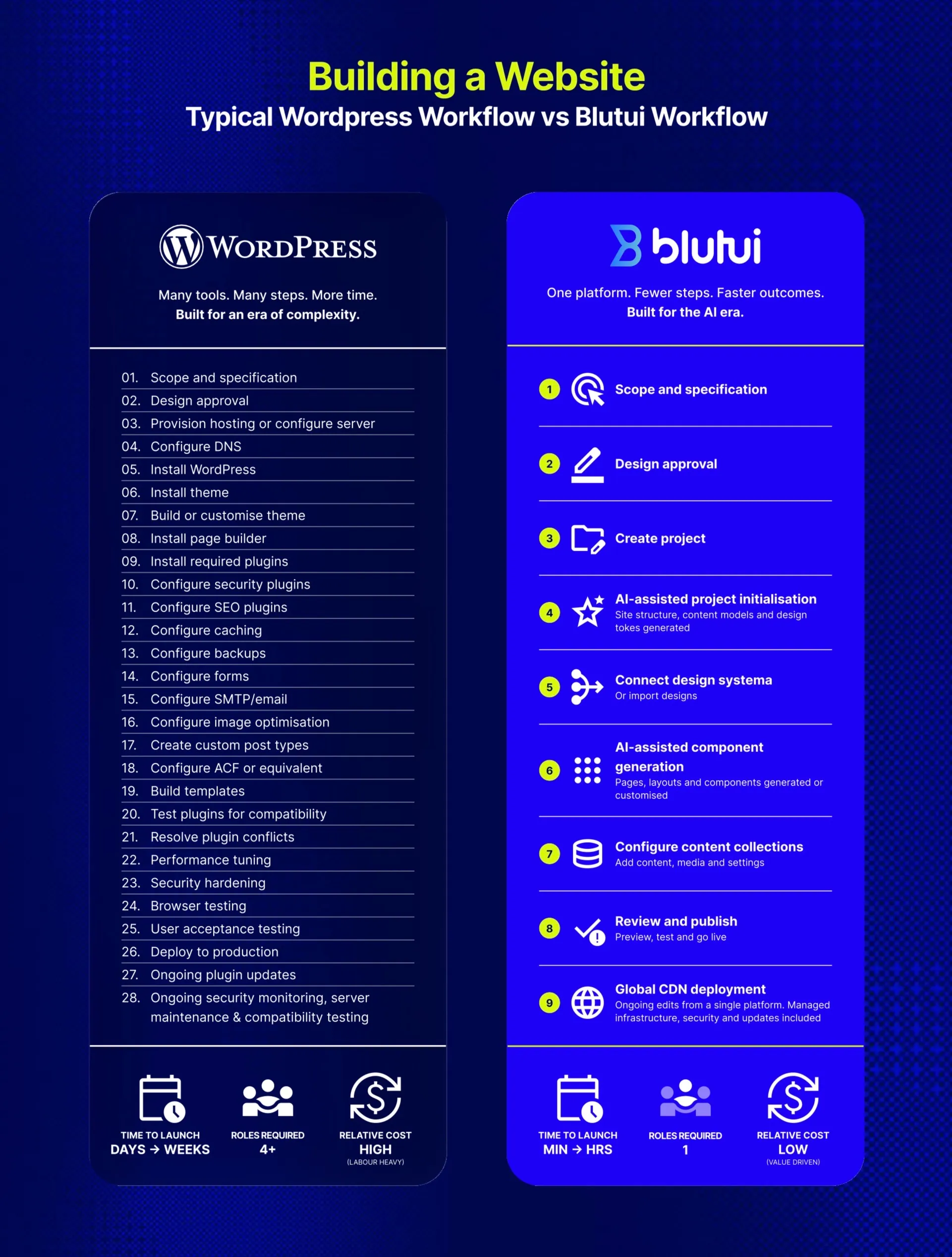
There was a time when complexity was good for business.
During the first three decades of the commercial internet, complexity created value because technology itself was inherently complex. Every meaningful advance demanded another layer of expertise. Organisations accumulated servers, databases, frameworks, plugins, security tools, deployment pipelines and integration layers because that was simply what building digital products required. As technology evolved, businesses evolved alongside it, adding new systems, new specialists and new processes to manage an increasingly intricate web of dependencies. Nobody deliberately set out to build organisations this way. Complexity wasn't engineered for its own sake. It emerged as the logical consequence of solving yesterday's problems with yesterday's technology.
Entire industries flourished because of that complexity. Agencies expanded their development teams, software companies built increasingly specialised products, and hosting providers, DevOps engineers, QA specialists, security consultants and systems administrators all became integral to delivering digital experiences. Complexity created scarcity, scarcity created expertise, and expertise created billable hours. For its time, it was an entirely rational commercial model. In many respects, it fuelled one of the most innovative periods the digital industry has ever experienced.
The challenge is that many organisations continue to evaluate themselves using assumptions that belonged to that era, even though the economics have fundamentally changed.
One of the most common objections to modern AI-native platforms is deceptively simple: "Why would we pay for software when the software we already use is free?" It sounds like prudent financial management, but it is often based on measuring the wrong cost. Software licences have rarely been the expensive part of digital delivery. The real expense has always been everything built around them: the infrastructure, hosting, security, maintenance, upgrades, plugin compatibility, deployment pipelines, governance processes, backups, monitoring and, most importantly, the people required to keep every moving part functioning together.
Every individual decision made sense when it was made. Each new requirement justified another tool, another process or another specialist. Yet over time those sensible decisions accumulated into operating models where an increasing proportion of organisational effort was devoted to maintaining the system rather than improving the outcome. What began as operational maturity slowly evolved into what might be described as an engineered complexity tax, one that grows quietly until organisations barely notice how much time, money and talent it consumes.
None of this is an indictment of the technologies that defined the previous generation of the web. Platforms such as WordPress transformed digital publishing, lowered barriers to entry and enabled thousands of agencies, developers and entrepreneurs to build successful businesses. They solved the problems of their time extraordinarily well. However, they were also products of an era in which complexity was expected and commercially valuable. They were designed for a world where assembling multiple independent technologies into a functioning solution represented expertise in itself.
Today's commercial environment rewards something very different.
Artificial intelligence, MCPs, agentic workflows and centrally managed cloud infrastructure are fundamentally changing the economics of digital delivery. Tasks that once justified teams of specialists are increasingly being automated or abstracted away entirely. Infrastructure that previously demanded dedicated in-house expertise is rapidly becoming a managed service. Workflows that relied on manual coordination between multiple disciplines are beginning to be orchestrated by intelligent systems capable of handling much of the repetitive work that once filled countless billable hours.
The consequence is profound. The value no longer lies in managing complexity. Increasingly, the value lies in eliminating it.
Consider two agencies delivering roughly fifty websites each year.
The first reflects the operating model that became standard over the past two decades. It employs project managers to coordinate increasingly complicated workflows, front-end and back-end developers to build and maintain websites, DevOps engineers to manage infrastructure, QA specialists to validate releases, systems administrators to maintain hosting environments and technical support staff to keep everything running once projects have launched. By the time the agency reaches a steady rhythm, around eighteen people are directly involved in delivering those fifty projects.
The second agency delivers exactly the same volume of work, but on a modern AI-native platform. Infrastructure is managed. Deployment is automated. Components are generated with AI assistance. Security, hosting, content management and global delivery are integrated into the platform rather than assembled from dozens of independent technologies. The agency still employs experienced designers, developers and strategists, but far fewer people are required to manage the machinery surrounding the work itself. Eight people comfortably produce the same annual output.
At this point, many people assume the modern agency must simply be replacing labour costs with expensive software licences. Yet the economics tell a different story. Even if every employee used a platform costing US$199 per user each month, eight licences would amount to US$1,592 per month, or just over US$19,000 annually. That may sound significant in isolation, until it is compared with the cost of employing a single experienced developer, which in many markets comfortably exceeds six figures before employment overheads. The annual software investment for the entire agency represents only a small fraction of the cost of maintaining the technical roles that legacy operating models require.
Viewed through that lens, the conversation changes completely. The question is no longer whether organisations can afford to pay for modern software. The real question is whether they can continue carrying operating models that were designed to manage complexity rather than eliminate it.
This is where leadership becomes genuinely difficult. The people within these organisations are talented. Their technology still functions. Their processes have often been refined over decades and their cultures have been built around delivering exceptional work. From inside the business there appears to be little urgency to change because everything still appears to be working.
The market, however, has already begun redefining what "good" looks like.
Customers rarely care how many systems support a service or how many specialists touch a project before it reaches them. They care about responsiveness, consistency, quality and speed. Increasingly, they expect those outcomes to improve while costs remain stable or even decline. Organisations built on simpler operating models are beginning to meet those expectations because they spend less time managing infrastructure and more time creating value. They move faster because there are fewer handoffs. They innovate more frequently because less effort is consumed by maintenance. Their experts devote more of their time to judgement, creativity and solving client problems instead of administering technology.
That is perhaps the most important distinction of all. The competitive advantage of the next decade will not come from employing more specialists. It will come from enabling specialists to spend almost all of their time doing the work only they can do, while intelligent systems quietly remove the operational friction around them.
This is why the conversation about AI is not fundamentally a technology story. It is a leadership story.
Every generation inherits an operating model shaped by the technological constraints of its time. The responsibility of leadership is recognising when those constraints no longer exist. For almost thirty years, the digital economy rewarded organisations for adding layers of capability because complexity itself created commercial opportunity. The AI economy is reversing that equation. It will reward organisations that remove complexity, simplify operations and focus human talent where it creates the greatest value.
History has consistently favoured businesses that simplify what others continue to complicate. There is little reason to believe this transition will be any different. The organisations that flourish over the next decade are unlikely to be those with the largest teams, the longest histories or the most sophisticated technology stacks. They will be those that recognise, earlier than their competitors, that the age of complexity as a competitive advantage is drawing to a close.
More from Articles























![400% [Put in context for agency founders]](https://cdn.blutui.com/uploads/curation/img-8327.jpeg)



Sign up for our newsletter.
We partner with some extraordinary organisations