Transform #24 Article
You Can't Prompt Sunday Night
You Can't Prompt the Client: Why the Agency Is the Signal
Agency Life 6 min read
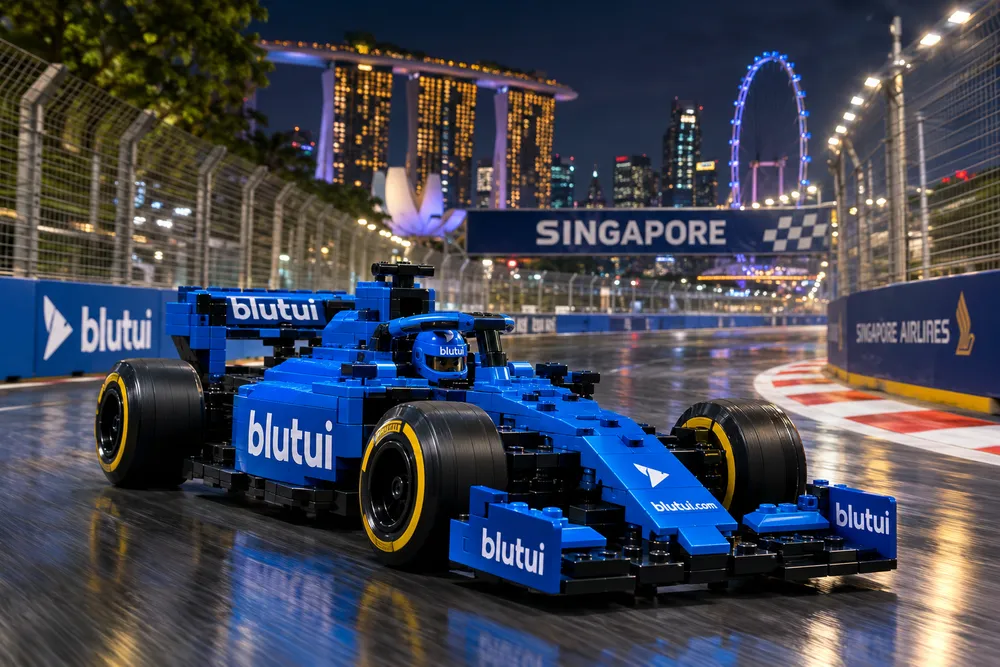
When the Formula 1 circus rolled into Singapore, Gustaf Wick wrote one of the sharpest marketing posts I've read all year. Gustaf worked in F1 back in the days of big tobacco, when the cars were rolling billboards for brands that couldn't advertise anywhere else. Today, he points out, team sponsorship is a multi-billion dollar business, and technology brands, including the frontier AI companies, are the fastest growing category.
His insight is the contradiction at the heart of that. The companies making content almost free to produce are paying large fortunes to stand next to something that can't be synthetically produced at all. A real driver. Real risk. A result nobody knows for absolute certain in advance. As Gustaf puts it: “you can prompt a thousand images of a race in seconds, but you can't prompt Sunday night.”
All credit to Gustaf for that line. I want to take it somewhere he didn't, into the agency studio. Because the same law of scarcity he describes in the paddock is now deciding which agencies win the next decade of work, and which quietly hand it away.
The agency is the livery, not the free post
Gustaf leans on Rory Sutherland's idea of the costly signal. A livery worth millions says something a thousand free AI posts never can: we are serious, we are confident, and we are here for the long run. The cost is the message.
Agencies carry a costly signal too. It just isn't emblazoned on a car. It's the years of relationship with a client. The strategist who knows why the CEO winces at certain words. The designer who was in the room when the brand vision was argued out at 9pm. The producer who will answer the phone when the app goes down on launch day. None of that can be generated, and none of it is cheap. That is exactly why clients value it.
The danger is that agencies forget this just as it becomes their most valuable asset. When the market floods with content anyone can make at no cost, the market prices it at no cost. The agencies that win will be the ones that double down on what can't be faked, and use AI to make more room for it, not less.
Paddock and studio: the same race
Put F1 and agency life side by side and the parallels are uncomfortably exact. Every part of a winning team has an agency equivalent, and every one of them is something a prompt alone can't supply.
In Formula 1 | In the agency | What a prompt alone gives you | What an Agency Web Ecosystem gives you |
The driver | Your creative and strategy leads | Nobody in the seat | Your people stay in the seat, with AI doing the laps they shouldn't have to |
Knowing the circuit | Knowing the client's business, market and politics | A blank context window | Shared agency context, components and standards reused across every client build |
The team principal's strategy | The client's long-term vision | Whatever the last prompt said | Brand rules and approved components that hold the vision from build to build |
The car | The production engine | A powerful engine with no chassis | Managed hosting, deployment automation, CDN, SSO and four nines plus availability |
The pit crew | Developers and producers | Rework, regeneration and "AI spaghetti" | Repeatable delivery: Courier CLI, Continuum webhooks, Cassettes for campaign sites |
The livery | Your agency brand on the relationship | Someone else's brand, or no brand | Full white labelling: your agency name on the client experience |
Telemetry | Proof of performance | Guesswork | Open API analytics, SEO and AEO built in |
The podium | Winning and keeping the account | A cheaper competitor wins next time | Agencies that compound value on every project |
The pattern is simple. The prompt engineer brings a tricked out engine. The agency brings the A-team capable of winning the race. An Agency Web Ecosystem is what connects the two and delivers creativity, control and margin.
A great engine with nobody in the seat
No team principal hands the car to a stranger who has never seen the track. Yet that is exactly what many agencies are doing with their clients right now.
The brief arrives. Someone blurts out "AI can build that." The work goes to a prompt engineer, inside the agency or outsourced, who has never met the client, doesn't know what they sell or who they sell to, and wasn't in the room when the vision was set. The output looks fine on day one. Day two and the problems start:
It drifts off brand. Every regeneration nudges the tone, the layout and the components a little further from what the client signed off.
It can't be repeated. One-off prompts don't become a system. The next campaign starts from zero, so the agency never gets faster.
It fragments. Different tools, different models, different hosting. What we call AI spaghetti, and it lands on the agency to untangle.
It erodes the relationship. If the agency's role shrinks to typing prompts, the client eventually asks why they need the agency at all.
That last point is the real cost. Handing work to the prompt isn't saving money. It's giving away the costly signal, the one thing clients can't get anywhere else. And as Gustaf says, if your content could have been made by anyone, at no cost, the market will value it accordingly.
The Agency Web Ecosystem is the team, not the engine
An F1 car is not a product you buy off a shelf. It's an ecosystem: chassis, power unit, telemetry, pit wall, garage, logistics, all engineered around one purpose, getting a driver onto the podium. Take any part away and the engine is just noise.
That is the idea behind the Blutui Agency Web Ecosystem, or AWE. It belongs in the same category conversation as CRM and ERP, not alongside a CMS or a DIY site builder. A CMS manages content. A site builder serves whoever turns up. An Agency Web Ecosystem is built around one purpose: making the agency win.
Blutui was born inside a working agency, after decades of watching agencies lose time, margin and creative energy to tech that was never built for them. It has always been agency-first. Here's what that means in practice:
Your livery, not ours. Full agency and project white labelling. The client relationship carries your name. We power delivery behind the scenes.
Your driver keeps the wheel. With createControl, front-end developers keep control of the code, frameworks and experience, while Blutui handles infrastructure and repetitive production.
Your client can drive the content, safely. Canopy 2.0 and Canopy Blocks let clients add and reorder sections and edit content without uncontrolled technical access, so the build stays on brand.
One chassis, many races. Cassettes run campaign sites and multiple front ends from unified production data. Collections, Context and AI Components mean every project builds on the last instead of starting from zero.
A pit crew that never sleeps. Managed hosting, CDN, SSO, deployment automation, Courier CLI and Continuum (headless plus webhooks), with four nines plus availability.
Telemetry you can show the client. Open API analytics plus SEO and AEO built in, so performance is proof, not opinion.
None of this replaces the agency. All of it amplifies the agency. That's the difference between a tool and an ecosystem.
Agentic when you want it, craft when it counts
Nobody in F1 is anti-technology. The teams that win are the most technical on the grid. But they are clear about where the machine ends and the human begins. The simulator runs ten thousand laps overnight. The driver still makes the call into Turn 1.
That is how Blutui treats AI. Agentic where it saves time. Human where it matters.
Agentic for the laps nobody should drive by hand. Through MCP and hybrid Agentic Skills, AI can scaffold components, move content, handle repetitive production and take a Figma prototype to a live build in minutes.
Your choice of engine. Blutui MCP connects to the models your agency chooses, not a platform-owned token ecosystem. That's AI freedom with cost control, and code access as a hedge if token prices climb.
Craft where the client feels it. Strategy, design, brand judgement, the moments that make a client say "that's us". Those stay with your people, because that is where the costly signal lives.
The result is an agency that moves at AI speed without becoming AI-generic. Faster delivery, healthier margin, and a team that spends its hours on the work only it can do.
Southeast Asia, it's time to get on the podium
Singapore hosts the world's most famous night race, and its agencies have every right to compete at the same level. The talent is here. The clients are here. Across Southeast Asia, from Singapore to Ho Chi Minh City, agencies are doing work that deserves the top step.
The question is whether they win the work, or hand it to the prompt.
So here's my challenge to agency leaders in the region. Step up. Want the work. Be the agency. Keep the client relationship, keep creative control, keep the margin. Let AI do the laps it's good at, and keep your people in the driver's seat.
Blutui is all in on helping Southeast Asian agencies get there. We give the agency, well, agency.
I'm in Singapore from 3 November. If you lead an agency here and want to talk about winning the work rather than handing it over, get in touch, or book a Fly-Through at Blutui.com. The coffee's on me.
Graeme Blake, Founder and CEO, Blutui. With special thanks 🙏 to Gustaf Wick, whose LinkedIn post on F1 in Singapore sparked this piece.
More from Transform #24
-

Agency Life 2 min read
Switching dog food? Go slow. Switching platforms? Same rule.What the back of the bag knows
-
Agency Life 6 min read
SEO Didn't Die. Your Website Got a Promotion.Thanks to GEO Your Website Got a New Job, a Raise and the Corner Office.
-
4 min read
BIMA Unlocks the UK's Digital Front DoorBIMA asked one of its own members to rebuild the website of the UK digital industry. Subvert Studio did the research first, built on Blutui, and delivered in around a third of the planned time. Here's what agency leaders can take from it.
-
Opinion 4 min read
Built It, Own It?Agencies and the Websites They Leave Behind
-
Product 5 min read
Say It Like You Mean It, in Every LanguageA Blutui Insight on AI, human linguists and multilingual web production for agencies