Articles Article
The Confident Obituary Con.
UI Isn’t Dead. It’s Time to Double Down.
Agency Life 6 min read
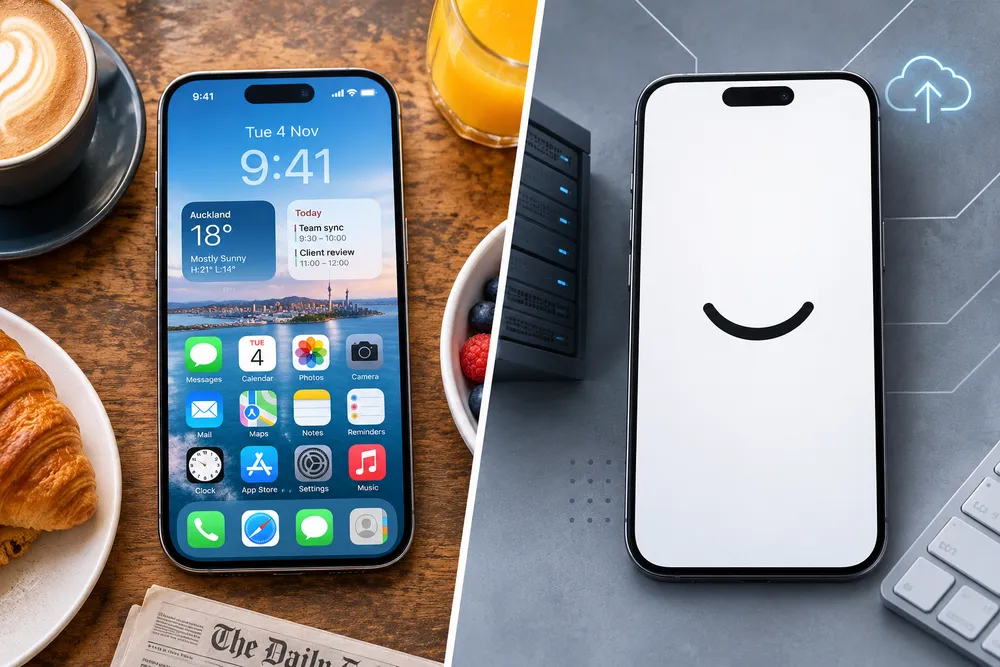
Every few weeks someone declares the user interface dead. Agents will book the ride, file the expense, buy the shoes. No screens, no buttons, no designers. You say what you want and it happens.
It is a seductive line. It sounds like the future, it travels well on LinkedIn, and it flatters anyone who never enjoyed paying for design in the first place.
The problem is not that the claim is bold. The problem is who acts on it. The people repeating it loudest are rarely the ones who have shipped a checkout, sat in a usability session or watched a real customer abandon a form halfway through. Yet their sweeping insight is already landing in boardrooms, budgets and briefs.
What the claim gets half right
Agents are changing how some work gets done, and anyone who denies that is simply not paying attention. Booking, triage, data entry and repetitive admin are moving from screens to sentences. That shift is real and it is welcome.
The serious voices behind the idea say something far more careful than the slogan. In April 2026, Sierra co-founder Bret Taylor said the era of clicking buttons is over, yet even the coverage of his comments expects buttons to survive as confirmations and fallbacks, and names discoverability and trust as open problems. Jakob Nielsen's "Goodbye UI Design" piece predicts a transition of at least ten years, urges teams to go slow with agents on important tasks, and insists on usability testing for every agent design.
So the people who know the most hedge the most. The danger lives in the retelling. By the time the idea reaches a pitch deck or a procurement meeting, every caveat has fallen off and "UI is changing" has become "UI is done".
What it gets wrong
The slogan treats an interface as a set of buttons. It never was. An interface is where a person decides whether to trust you, understands what is happening and checks that it went right.
Trust. People judge a brand in seconds by how it looks and behaves. Remove the surface and you remove the place that trust is earned.
Comprehension. A screen shows you what is possible. A blank chat box asks you to guess.
Verification. When an agent acts on your behalf, you need somewhere to see what it did, approve it and undo it. That somewhere is a UI.
Brand. Agents summarise and restyle. Every business starts to sound the same unless it owns a place where it can look and feel like itself.
Accessibility. The idea that agents make accessibility obsolete asks disabled people to hand their independence to a system that still makes mistakes, years before anyone else would accept the same deal.
Agents do not make interfaces disappear. They move the interface to the moments that carry the most weight: deciding, approving, correcting and feeling something about a brand.
The brief has doubled
Here is the irony. Far from shrinking, the brief has arguably doubled. Every agency now builds simultaneously for dual audiences: the human who visits, feels and decides, and the agent that reads, parses and acts on a human's behalf. Increasingly, that agent is also the one recommending the brand to the human in the first place.
Those audiences want different things. People want clarity, emotion, brand and confidence. Agents want clean structure, consistent data and actions they can call without guessing. A site that delights people but confuses agents gets skipped. A site that serves agents but leaves people cold loses the sale at the moment of trust.
Getting both right at once is a balancing act with stakes higher than anything the web has asked of agencies before. Content has to be written for readers and for machines. Components have to look right and be described right. Every action has to work for a finger on a screen and for an agent calling it in the background, with the same outcome and the same accountability.
That is more craft, not less. It needs designers, front-end developers, content people and engineers working from one system. The "UI is dead" crowd are asking agencies to cut the exact people this doubled brief depends on.
The downstream danger
A bad idea repeated and amplified with confidence does not stay an idea. It becomes a budget line. Here is how the cascade runs once the off-hand "UI is dead" remark reaches people who make decisions but have never made an interface.
The brief shrinks. Clients start asking why they are paying for design when "the agent will handle it". Discovery, prototyping and testing are the first things cut, at the exact moment the work has doubled.
The talent walks. Agencies under margin pressure trim their designers and front-end developers, the people who turn strategy into something a customer can use. That craft takes years to build and weeks to lose.
The product goes generic. Without people who care how a thing looks and feels, sites and apps default to whatever the tool spits out. Brands blur into one another.
The gaps fill with AI spaghetti. Interfaces get generated on the fly, by different tools, with no system behind them. Nobody owns consistency, quality or the cost of fixing it later.
Accountability disappears. When an agent takes the wrong action and there is no clear surface showing what happened, the customer cannot see it, the brand cannot explain it and nobody can fix it fast.
Trust erodes and bad actors move in. A web where nobody checks what they are looking at is a gift to scammers. Clear, owned, recognisable interfaces are part of how people tell the real from the fake.
None of these steps needs anyone to be malicious. It only needs someone senior to believe a headline.
Who pays
The people who post the obituary rarely pay for it. Everyone downstream does.
Agencies lose the craft that makes them worth hiring, then compete on price with tools that cost a fraction of a team.
Brands lose the one place they fully control, and hand their customer relationship to whichever agent sits in the middle.
End users lose the ability to see, check and choose. The least confident and least digitally fluent lose the most.
In my 30 years in this industry I have watched plenty of "X is dead" moments. The homepage, the website, the designer. Each time the thing changed shape. Each time the businesses that panicked and cut first spent the next three years rebuilding what they threw away.
What to do instead
The answer is not to resist agents. It is to put them in their place. Agentic where it saves time. Human where people need to see, decide and trust.
Design for both audiences. Make content and actions readable by agents, and keep a human surface that is clear, branded and accountable.
Treat the interface as the control room. Every agent action should land somewhere a person can see, approve and reverse.
Keep front-end folk at the core. Designers and front-end developers are the people who know how to make AI output usable, consistent and on brand. Invest in them, do not cut them.
Build on a system, not a pile of prompts. Structure, components and governance stop AI-generated work from turning into spaghetti.
Question the headline. Before a slogan changes a budget, ask who said it, what they hedged and whether they have ever shipped the thing they are calling dead.
This is the thinking behind Blutui, an Agency Web Ecosystem built inside a working agency. We bring AI under control so agency talent goes further, rather than pretending the craft no longer counts.
The interface is not dying. It is being tested.
UI is not a thing of the past. It is the part of the experience that now carries more responsibility than ever, because it is where humans stay in charge of the machines acting for them.
The real risk is not that agents arrive. It is that confident, uninformed voices convince decision makers to dismantle the craft, the people and the systems we will need most when they do.
So next time someone tells you UI is dead, ask them one question: when the agent gets it wrong, where will your customer go to find out?
Sources
The End of the "Button-Clicking Era": Bret Taylor on redefining UI through AI agents, AI Watch, April 2026
Hello AI Agents: Goodbye UI Design, RIP Accessibility, Jakob Nielsen, February 2025
More Articles
-
Product 5 min read
How we built browser login for Courier with the OAuth device grantCourier now logs in through the browser with the OAuth device grant, and why we chose it over PKCE.
-

4 min read
Head in the Sand or Hair on FireMost agencies I talk to are standing somewhere on a line. At one end, nothing changes. At the other end, everything changes at once, with nobody holding the wheel.
-

6 min read
The Content Debt Nobody Budgeted For.Vibe coding made websites cheap to build. Turns out it's made them expensive to own. And the bill is landing on clients.
-

Agency Life 4 min read
Agency Advisory | 22 Oct 2026 (NZT)Legacy PHP Vulnerabilities and Your Clients' Websites