Published July 23, 2026
When An Agency's Response Is . . . Crickets
Structure and Certainty Are The Next Frontiers in AI Orchestration

There is an awkward conversation waiting around the corner for a load of agencies.
Not today. Perhaps not even this quarter. But somewhere in the not too distant future, an account manager is going to receive a perfectly reasonable email from a client.
"We're expanding the site into multiple regions. We need to integrate with our new CRM. Can we add a customer portal? Our security team have a few questions. Can your devs jump on a call?"
And then...
Crrrrrrrrrrrickets.
Not because the agency doesn't care.
Because nobody actually knows how the project was built.
Over the past two years AI has made it remarkably easy to generate website code. Entire projects can appear in minutes. Landing pages look polished, on the surface at least. Components are assembled at incredible speed. The demonstrations are impressive and the first client presentation often goes exceptionally well.
Until the project needs to become a real business application.
That's where many agencies are quietly creating a problem for themselves.
Increasingly, projects are no longer being built by experienced developers following established engineering practices. They're being generated by whoever happens to have a Claude subscription, a ChatGPT account, or enough confidence to guess at what a good website should look like or at least prompt the scope of work document.
The experienced developer who originally set everything up has moved on. Documentation is sparse. The prompting history has disappeared. The architectural decisions only ever existed inside an AI conversation that nobody saved.
The website works, until it doesn't.
The uncomfortable reality is that AI is exceptionally good at producing outputs. It is far less concerned with producing systems that can be maintained or expanded on by a human being twelve months later.
Clients rarely buy websites that stay exactly as they were on launch day.
Businesses evolve. Campaigns become platforms. Landing pages become customer journeys. Marketing microsites become operational systems.
What began life as a five page promotional website suddenly requires authentication, localisation, workflow automation, third-party integrations, accessibility compliance, governance, security reviews and performance optimisation.
That is the point where agencies discover whether they built a website or accumulated technical debt.
The irony is that AI isn't the real problem, it’s part of the solution. Remember I said part. The absence of development guardrails or a standardised orchestration framework is.
Professionals have spent decades developing standards around coding conventions, reusable components, deployment processes, version control, testing, documentation and governance because they know that software is never finished. It simply enters its next phase of evolution.
When those disciplines disappear because "the AI wrote it," the agency hasn't eliminated engineering. It has simply postponed it until the client needs something important, in a huge hurry usually.
Those delayed costs rarely arrive quietly. They arrive during board presentations, product launches, earnings calls and acquisitions, compliance audits.
During moments when the client expects confident answers and rapid delivery from their trusted agency partner.
Instead, the agency's response is, you guessed it ... crickets.
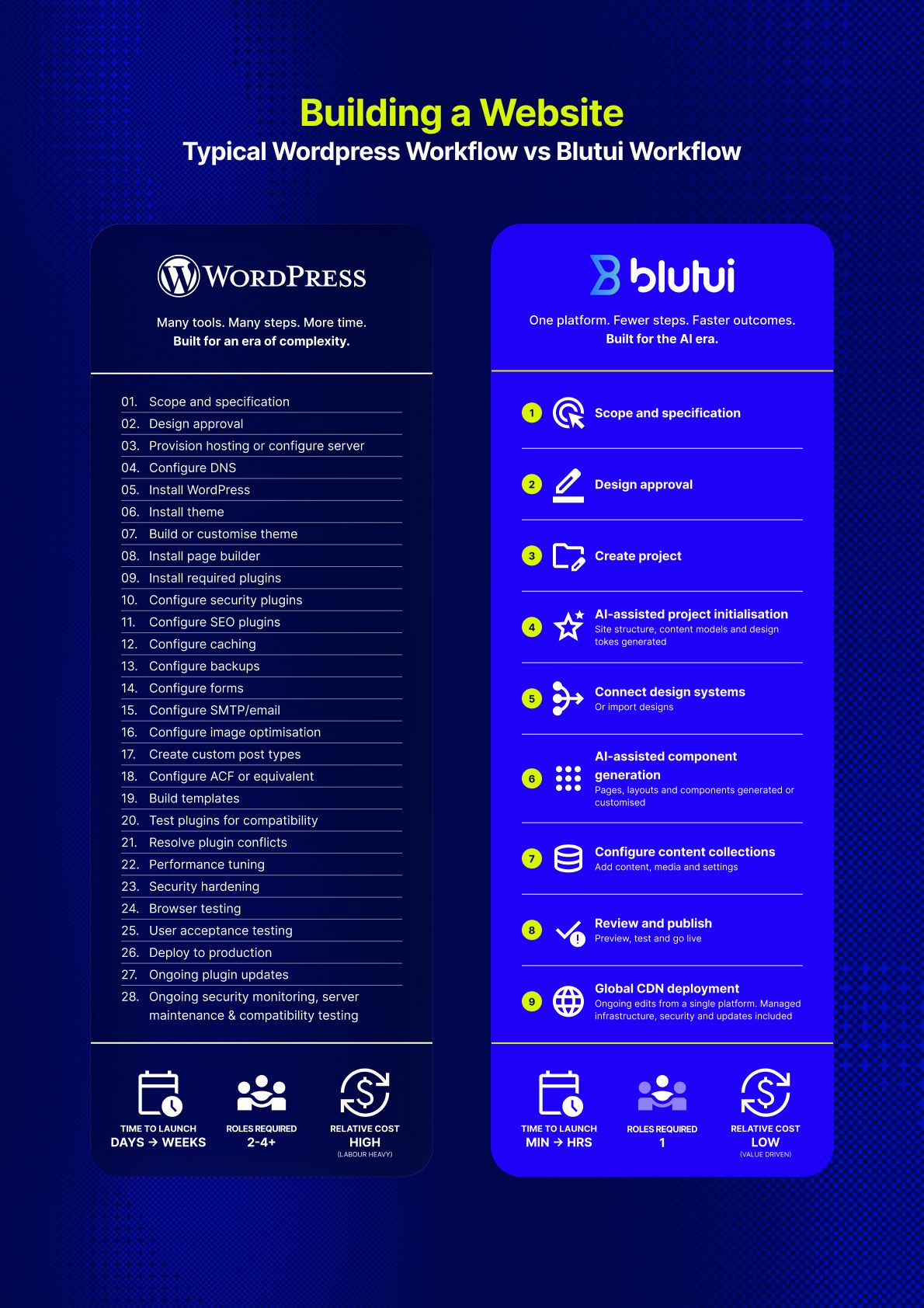
That scenario is precisely why we built Blutui.
Blutui was never intended to replace developers, quite the opposite.
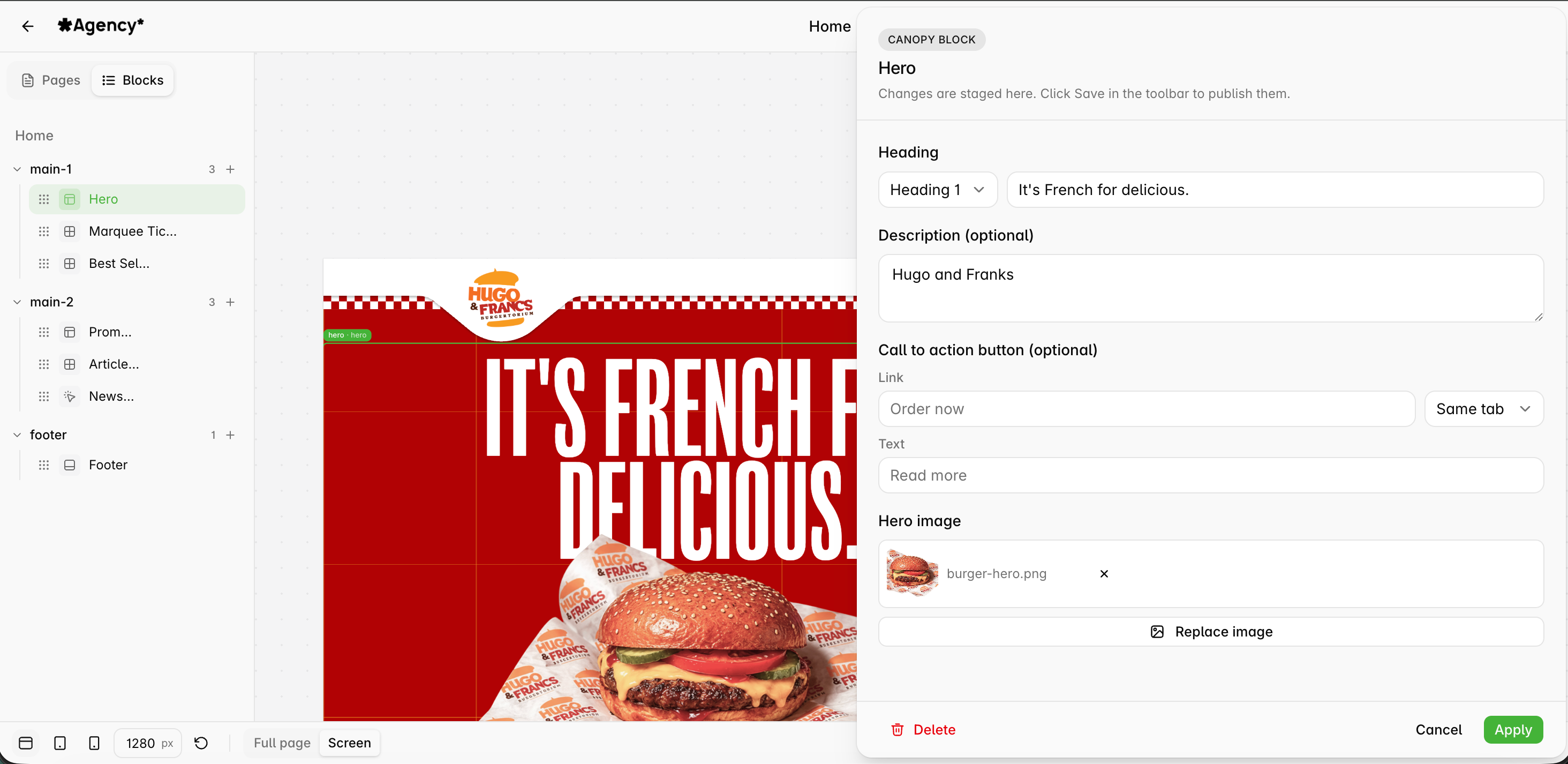
It was designed to make every front-end developer, and increasingly every AI-assisted developer, produce work inside a consistent framework of governance, structure and best practice.
AI can generate components, it's happening in the Blutui platform all day long. Blutui governs how those components fit together.
AI can produce code, it's happening in the Blutui platform around the clock. Blutui provides the architectural consistency that allows another developer to understand, extend and maintain that code months or years later.
AI accelerates production, that's happening on Blutui projects in agencies throughout Adland. Blutui ensures that acceleration doesn't come at the expense of maintainability.
As projects grow beyond a simple micro or poster site, consistency and workflow structure becomes as valuable as speed. The agencies that thrive over the next decade will not necessarily be the ones generating the most code. They will be the ones generating code that every member of the team can confidently inherit, understand and evolve.
Clients don't buy a website because they want a collection of code. They’re buying confidence, continuity. They invest in the assurance that the agency they trust today will still be able to support, extend and improve that investment tomorrow without tearing up the original cheque and endure endless migrations and cost.
That confidence doesn't come from whichever frontier AI model happens to be popular this month. It comes from the systems, governance and engineering discipline underpinning it.
The agencies embracing AI without those foundations may one day discover that generating a website was the easy part, because often it is. Explaining it two months or two years later to a client who doesn’t want to ‘simply rebuild it again, fresh’. Now that can be considerably harder, it can even lose you the account.
When that email eventually arrives asking for the next phase of the project, every agency wants their response to begin with, "Absolutely." But there are agencies out there framing their response with 'how do we sell them on a whole new project'. Mic drop, silence, crrrrrickets.
Our own Blutui CEO, Graeme Blake, a career digital agency leader says it best, “If anything, this current vibe coding trend reinforces a simple truth. AI is rapidly democratising code generation, but it is not democratising solutions architecture or fundamental software engineering. There is still enormous value in platforms that provide consistency, governance, maintainability and institutional knowledge across businesses, networks and industries. That is the gap Blutui was built to bridge.”



Sign up for our newsletter.
We partner with some extraordinary organisations